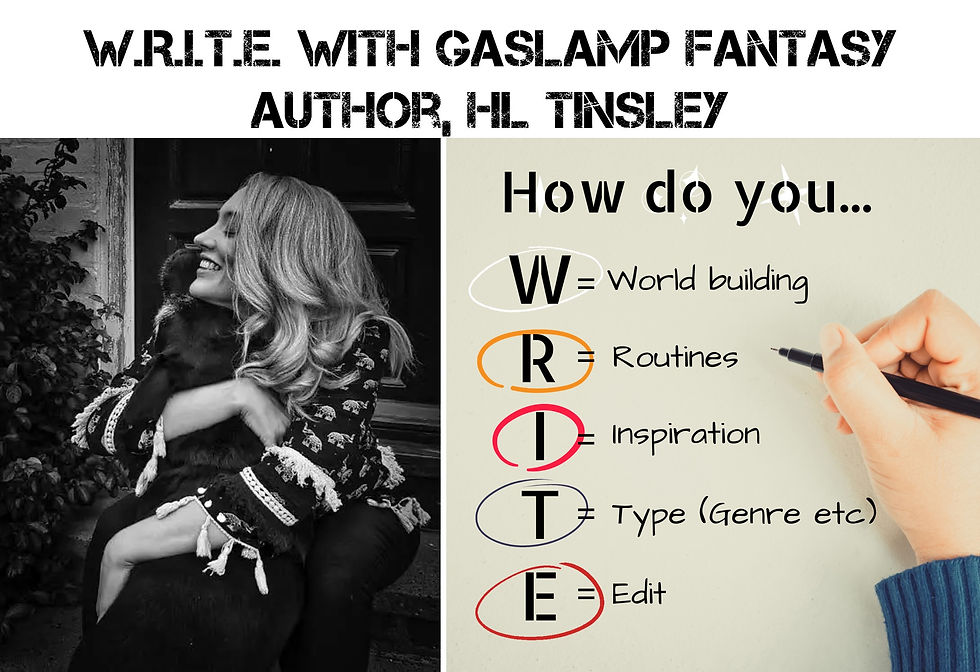
W.R.I.T.E. with Tim Hardie
- Jan 10
- 13 min read
Updated: Jan 11
Tim Hardie grew up in the seaside town of Southport during the 1970s and 1980s. This was before anyone had even heard of the internet and Dungeons & Dragons was cutting edge. Living in a house where every available wall was given over to bookshelves, he discovered fantasy writers like JRR Tolkien, Michael Moorcock, Ursula Le Guin, Alan Garner, Stephen Donaldson and Susan Cooper. Those stories led him into the science fiction worlds created by Frank Herbert, Philip K Dick, Arthur C Clarke and HP Lovecraft.

After training to become a lawyer Tim lived in London for three years before moving to Yorkshire in 1999, where he has worked ever since in a variety of legal, commercial, financial and management roles. His writing began as a hobby in his early twenties and has gradually grown into something else that now threatens to derail his promising career. Tim writes epic fantasy that will appeal to fans of Joe Abercrombie, John Gwynne and Robin Hobb.
Tim has made me super jealous by sharing pictures on social media of his European Tour and also the success of his novels which consistently get great reviews. I finally pinned him down for this interview, presumably before he sets off on a world tour or writes another successful series!
1. Tim Hardie is the creator of the Viking inspired Brotherhood of the Eagle epic fantasy series. Its opening novel, Hall of Bones, was a finalist in 2021 SPFBO and also a semi-finalist in the Book Bloggers’ Novel of the Year Award 2023. Tim, putting your modesty aside, what’s made this series successful?
Thanks for that lovely introduction! And you’re absolutely right. This is a tough business, so it is really important to celebrate your successes.
When I began Brotherhood I did set out with the intention to entertain my readers as well as surprise them. I think the series works because it has enough of what people expect to find in epic fantasy, and the Viking-inspired setting is something most people are familiar with at some level, which enables them to jump right in and feel at home. At the same time the series subverts certain fantasy tropes and the plot is full of surprises, which keeps people guessing throughout. I think those are the main reasons why it has generally been well-received by critics and readers.
2. Let’s start with the W in this oh-so-contrived-concept, W.R.I.T.E. - W is for World Building. Along with your novels, you’ve written short stories too, which include A Roll of the Dice that builds on the lore and history of The Brotherhood of the Eagle universe. It’s a fascinating development, one which suggests your world building is incredibly clear. Tell us about it.
For every novel and series I write I create a set of background notes for the location, general historical details and a full bio for every character who appears. Taken together, those various notes contain the lore of the fantasy world of Amuran. If I’m being perfectly honest, it’s all a bit of a mess! Imagine a very disorganised virtual office with papers strewn all about the place. Some elements are no longer cannon as well and need updating to reflect what’s happened in the books. I recently set up my own Patreon and one element of this is going to be building up a specific ‘Lore’ section on there that contains definitive information set out in a logical and accessible format. Put another way, I’m trying to incentivise myself to organise all my notes once and for all!
As for A Roll of the Dice, that really came about because I ran my own Kickstarter fundraiser in 2024 to record the Hall of Bones audiobook. I wanted to make sure something brand new was created to help reward my backers for making that audiobook project happen and that short story collection was the result. Since 2021 I have been writing short stories more. It’s a great way to explore certain concepts and see if the premise or characters demand something more, which has resulted in three separate novel projects emerging from those ideas. In other cases, the short story is just that but it enables me to expand on a character’s background where there was no room for that in the main novels, or simply to fill in a bit of history and establish another world building element.
3. R is for Routine: what does your writer’s routine look like? Are you the disciplined sort that sets yourself goals and does everything to meet them or does writing sort-of happen?
I think there’s a fine line between having goals and trying to force it. For example, I’m writing the answers to this interview today because I just wasn’t feeling creatively inspired to write my current novel. I really enjoy doing stuff like this as well, which still helps me further my general author goals. Being an author is about so much more than just writing the books. By giving myself a break that means I should be fresh tomorrow morning, which is when I’ll give some time over to creative writing.
As a result, I don’t set myself daily word counts or anything like that. Instead, I carve out time when I know I’ll have the space to write and then use that time in the way that appeals to me. I have to fit writing around a full-time job and family commitments, so when the kids were young I was a classic nighttime writer, working until midnight once they were in bed. Nowadays, they’re up later than me! Now I’m older, I tend to do creative writing on Saturday and Sunday mornings, and I have set aside Fridays (my non-working day) to keep up with author administration, when my energy levels are generally lower following a full week at work.
Whatever your creative process, anyone who has written a book knows it doesn't just happen! You have to sacrifice other things to create the space you need to get the words down on the page. In my case, I watch much less TV and sport in particular had to go if I wanted the time to do this. Everyone is different and it’s about finding a routine that works for you.
4. I stands for Inspiration. You credit JRR Tolkien, Michael Moorcock, Ursula Le Guin, Alan Garner, Stephen Donaldson and Susan Cooper as major influences on you as a younger man and that books were a massive feature of your childhood home. How did these influences turn you into an author? After all, not everyone who reads these books become authors too!
I’m a firm believer in the saying that if you want to write, first you must read. As literacy rates fall around the world I do worry that future generations are losing a key skill that defines what it means to be human. We’re constantly tempted to take the easy short cut and seek out instant rewards when it comes to entertainment and information. However, if you don’t read you’re missing out on so much!
"Reading gave me enormous pleasure as a child and teenager and for me it’s a crucial part of your mental development. Reading enables you to sharpen your critical thinking by considering ideas and concepts outside your normal frame of reference. It helps you learn empathy for other people as you experience their thoughts and feelings, especially if those are the opposite of your own opinions and beliefs. There’s also the element of escapism that comes with books and they’re a less passive medium than film or TV, because you have to engage your own imagination to enjoy a book."
As a writer you need to understand all of that to produce good writing yourself and, crucially, characters and plot which interest and engage your readers. I don’t think you can do that if you don’t understand what good writing looks like in the first place.
Of course, not every avid reader is going to turn into a creative writer. There are far more readers out there than there are writers. However, I’d argue that every author started out as one of those avid readers, once upon a time.
5. The T in this sequence refers to Type (yes, mega contrived!). Epic fantasy is a wide and diverse genre these days, pin your work down for us, what should we expect from your stories, think of it like a recipe!
I’d describe Brotherhood as dark epic fantasy in a Viking-inspired setting. The story does go to some dark places, although there’s also some humour and friendship in there as well so it’s not unrelentingly dark, which is a style of book I generally dislike reading. My standalone, A Quiet Vengeance, is set in the same world but in a different continent. The feel of that book is drawn from the Middle East and North Africa, and it’s more of a low fantasy political thriller.
My current project, The Silent Division, is a gaslamp fantasy with a late 1800s European setting. This is a good example of a short story leading to something more! In all of my books, I’d say the common features readers will find are complex and diverse characters and plenty of twists and turns in the plot.
6. With E for Edit, we’re talking about getting your books ready to be launched into the world. How do you know it’s ready? What processes do you go through with your book to ensure it reaches the standards expected by a highly perceptive readership?
I edit my own work and have refined that process considerably over the past five years as this is a skill that requires a lot of practice. For line editing and proofreading I now use the read aloud function on Microsoft Word. It was a game changer for me in terms of picking up when the rhythm of a sentence wasn’t right. It’s also useful in highlighting what you have actually written, rather than what you think you’ve written. This is really helpful for catching typos the human eye often overlooks. For these aspects I listen to the book two or three times from start to finish and I don’t stop until I stop finding errors. On that point, over-familiarity with the text is the biggest issue when it comes to proofing your work. If you can bring yourself to put the manuscript away for at least a month, it does make it much easier to spot errors when you go back to it.
Knowing when you need outside input is also important. My agent John Jarrold is also my development editor, so once I have a first draft he’s one of the first people to read it. John’s great at pointing out if something isn’t working in terms of plot, phrasing or character consistency/believability. I’m also part of a writing group, so I will ask them to beta read if I feel I need more input in those areas.
"My main advice when it comes to editing is don’t rush the process. Almost every book I’ve read has contained at least one error I’ve spotted, so some inevitably slip through, but you want to present readers with the best possible version of your work. It’s better to be a few months late and get it right, rather than rushing and putting out something that could be better."
7. It was tempting to use the R in the acronym as the means to talk about another side to you - Tim Hardie the Reviewer. Your insights feature on the Page Chewing and Spotlight Indie blogs. What prompted you to become a reviewer? Is it connected to being a writer?
When I started out as an author I realised how important reviewers are when it comes to helping readers find the right book for them. I also started to read more as a writer than I had done previously. I read critically to understand why a book is or isn’t working for me. Reading excellent books by brilliant writers is the best way to develop your own craft.
I felt it was important to review the books I was reading in this way and give something back, rather than merely consuming them. I’ve been very grateful to both Page Chewing and Spotlight Indie for giving my reviews a home. I didn’t want to set myself up with my own review blog since I don’t generally take requests. I’m a relatively slow reader and the turnaround time when I do accept them can be years. Being part of a group of reviewers is much easier and it means there’s not constant pressure to write the next review compared to when you’re doing this solo.
I prune my to be read pile on a regular basis. I also read the book which calls to me, not the one I feel I should be reading. I want to be in the right frame of mind when I pick up a particular title, rather than doing so out of obligation. That gives the book the best possible chance of getting a good review!
8. That I in the acronym serves a double purpose. I is for Independence. You self-publish your books. Tell us why and what you’ve learned about the publishing industry in the meantime.
When I started out writing fiction in 2005 the independent publication scene was much less developed than it is today. I initially went down the traditional publication route because I didn’t really understand there was an alternative option. I acquired an agent in 2015 and Hall of Bones and A Quiet Vengeance both got some interest and good feedback from some of the publishing houses. However, getting accepted as a new author is very difficult and ultimately they passed on both those projects.
I knew my writing was of a publishable standard and I felt readers should be given the opportunity to read my work, so I went independent in 2020 and haven’t looked back since. These days I describe myself as an aspiring hybrid author as I’m still agented, since this opens up the door to things like translation rights and TV and film options. I’m also not in the camp that one route to market is intrinsically better than the other. I would still seriously consider a traditional publication deal if it were offered to me and I will be seeing if there is interest in some of my future projects.
The traditional publication route is very hard. Your chances of even getting an agent are only around 1-2% when compared with the number of submissions they reject every week. What I hadn’t realised was getting publishers to accept your manuscript is similarly difficult and much depends upon chance and who else they have on their books. However, if you want your physical books to be widely available in bookshops this is the route you have to go down.
Indie publishing has much to recommend it and I love the sheer variety of work being produced in this space, which would likely never find a traditional publisher. We have a wealth of choice when it comes to fiction these days and I think that’s a good thing. However, indie publishing is also very hard and I have struggled to find the numbers of readers that would justify doing this if you were looking at it purely from a commercial point of view. Authors like me write for the love of the craft and that has its own reward, for sure, but I also want a readership that makes this sustainable in the long term, even if it’s not my main income.
That’s why I’m exploring all the options at the moment. Completing my Brotherhood series has also allowed me to begin work on various new projects, and that’s been a lot of fun as well.
9. If it had been possible to squeeze an A into the Highly Contrived Concept of W.R.I.T.E. it would have included A for Admire. Which modern, (current) authors do you admire and why?
I’ve drawn inspiration from various authors over the years. The following have been particularly important for me more recently:
Joe Abercrombie – For teaching me the importance of having a compelling voice as an author.
Robin Hobb – Her books showed me how character drives a story and is essential for a successful novel.
John Gwynne – I’d highlight his work for showing how you can take a genre like epic fantasy and make it feel fresh and new.
David Barnett – A writer who uses plot brilliantly to tell his stories. His English folk horror novel, Withered Hill, was my favourite book of the past 12 months.
PL Stuart – For showing me the value of the wider reviewing and blogging community. He also demonstrates a work ethic that puts everyone else to shame!
HL Tinsley – She always challenges me and helps me push the boundaries, both in terms of my own creativity and also the wider projects I have become involved in. For example, I wouldn’t have had the confidence to run my own Kickstarter had I not previously been involved in her horror anthology project The Anatomy of Fear in 2023.
"One of the things I’ve valued the most since becoming an independent author has been the sense of fellowship and support found amongst the reading, writing, blogging and reviewing communities. I used to think writing was a solitary profession and it turns out I was completely wrong!"
10. What does 2026 promise for Tim Hardie: Fantasy Author?
2026 is going to be a very busy year…
For starters, I’m going to be marketing the Brotherhood of the Eagle omnibus. This gathers together all four books in one 1,900 page eBook volume for the first time, with brand new maps and four bonus short stories as well. I released this on 1st January 2026 and you can pick up a copy here.
I also hope to finish edits on The Wolf Throne in January or February. This is a prequel novel to events in Brotherhood, and the manuscript is currently with my editor. The plan is to go on submission and see if there’s interest in traditional publication. That means there’s going to be a delay before the book comes out, although I have made the original version of this novel available to my newsletter subscribers. If you can’t wait to read The Wolf Throne then you can subscribe and read all the instalments released to date here!
The Silent Division is my current gaslamp fantasy writing project and is another manuscript I want to submit to traditional publishers. The goal is to have this written by the first half of 2026 and then explore those options further.
A Quiet Betrayal is the follow up to my standalone novel A Quiet Vengeance and will be my next planned independent fantasy release. I’m aiming to begin writing this in the second half of 2026. I’ll have a better idea of publication timescales once I’ve finished working on The Silent Division. I also have plans to relaunch A Quiet Vengeance as well and discussions are already well underway on that front.
One of the best things which happened in 2025 was I joined the Spotlight Indie team. Spotlight Indie is a growing community of writers focussing, unsurprisingly, on independent speculative fiction. They have their own YouTube channel and organise both in-person and online events. There’s lots planned for 2026 and I’m really excited about joining them on this journey and being part of something that’s a positive, supportive force for independent creatives.
Finally, I intend to begin offering paid editorial services. I’ve been thinking about doing this for a while. Now the omnibus is finished this is a service I want to offer to other authors and I’ll be launching this as a new business later this year. Watch this space for further news on that front.
Tell us how we can find you on social media and the internet.
Thanks so much for taking the time and trouble to interview me, Phil! If people want to connect and stay in touch they can find me at the following places:
X – @TimHardieAuthor
Facebook – @Tim.Hardie.Author.Public
Bluesky – @timhardieauthor.bsky.social
Instagram – @timhardieauthor
Website – www.timhardieauthor.co.uk
Patreon – www.patreon.com/TimHardieAuthor

I'm Phil Parker - click the image to find out more about my books.